Portland Forest School and Nature Camps Guide
Portland has 35 nature and outdoor camps including forest schools. What makes them different, why they matter, and how to choose the right one for your kid.
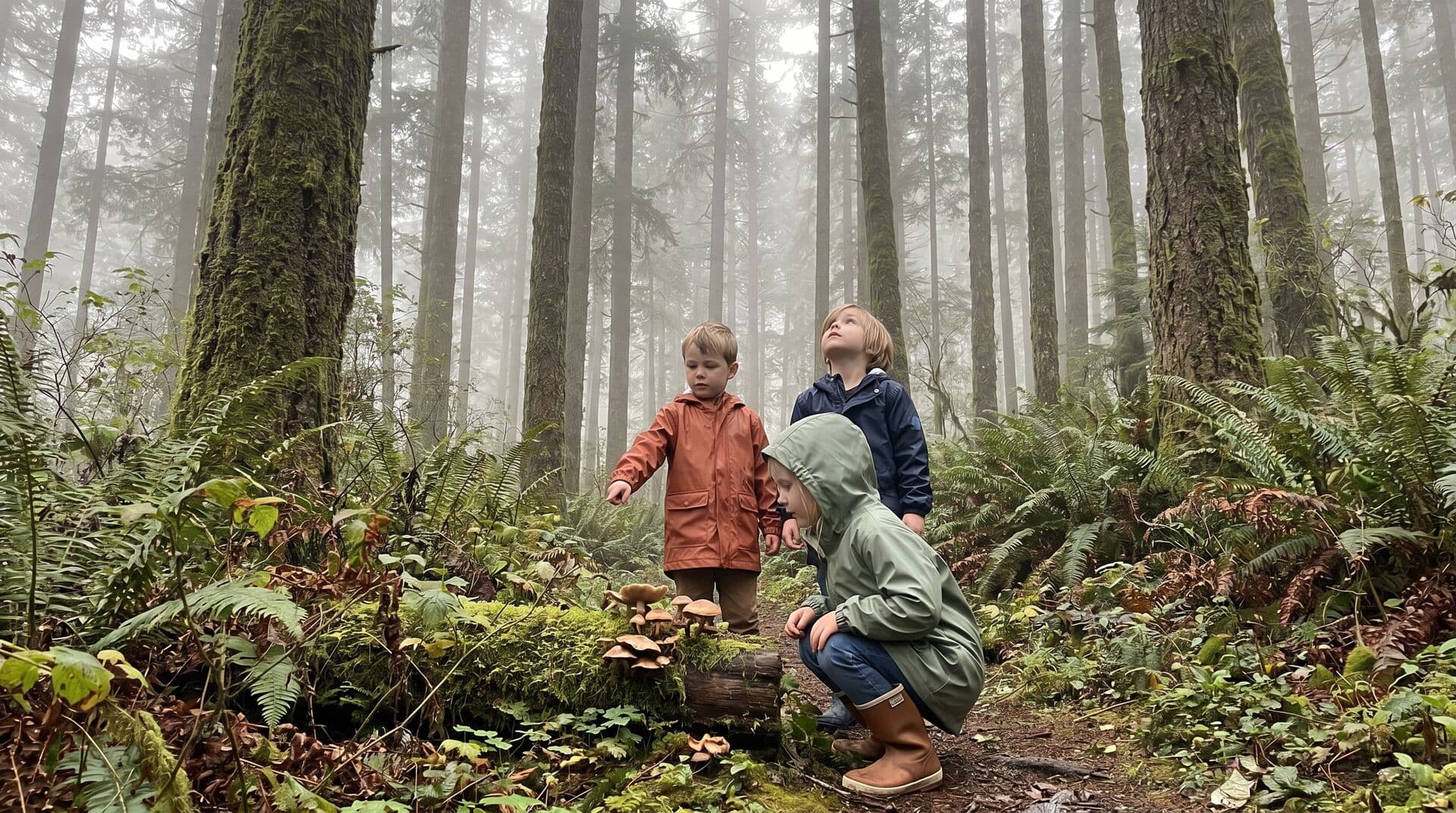
There's a preschool in Portland where kids spend the entire day outside, regardless of weather.
Not a field trip day. Every day. Rain, mud, cold, outside. The classroom is a forest. The curriculum is the natural world. The teachers are called guides.
This is Down to Earth Forest School, a nonprofit in the Portland metro area that serves preschool through 5th grade students. It's not unique in Portland. PDX Forest Preschool does the same for ages 3-5. Portland Forest School serves K-8. Trackers Earth runs an outdoor forest preschool for ages 4-5. Bird Alliance of Oregon runs nature camps that have been operating for decades.
Portland has, quietly, become one of the most developed forest school ecosystems in the United States. Based on our review of 234 Portland-area camps, 35 are outdoor and nature-focused. And most Portland parents, even the ones who live here, don't fully understand what that means or why it matters.
Key Takeaways
- Portland has 35 outdoor and nature camps, making it one of the strongest forest school ecosystems in the U.S.
- Forest school, nature camp, and outdoor adventure camp are three distinct models with different philosophies, and the right fit depends on your child's temperament.
- Children who spend regular time in nature show 27% better attention and self-regulation (Frontiers in Psychology, 2019).
- Oregon's rain culture is a feature, not a bug. Proper gear (rain jacket, waterproof boots, extra socks) makes the difference.
- Portland's 5,200-acre Forest Park gives local programs a natural advantage most U.S. cities can't match.
What are the top portland nature and outdoor camps?
Here's a quick reference for the major outdoor and nature programs running summer 2026 in Portland.
| Program | Type | Ages | Price/Week | Location | Focus |
|---|---|---|---|---|---|
| Trackers Earth | Nature camp / forest school | 4-17 | $350-$500 | 4 PDX locations + Sandy farm | Wilderness skills, tracking, survival |
| Bird Alliance of Oregon | Nature camp | 5-12 | $300-$375 | Pittock Sanctuary, West Hills | Birds, wildlife, ecology |
| Down to Earth Forest School | Forest school | 3-10 | $325-$400 | Various natural areas | Child-led nature immersion |
| PDX Forest Preschool | Forest school | 3-5 | $300-$350 | Forest Park area | Early childhood outdoor education |
| Portland Forest School | Forest school | 5-14 | $275-$375 | Multiple sites | Place-based outdoor learning |
| Tryon Forest Adventures | Nature camp | 6-12 | $250-$350 | Tryon Creek State Natural Area | Creek exploration, forest ecology |
| Avid4 Adventure | Outdoor adventure | 7-13 | $400-$500 | Parks throughout Portland | Kayaking, biking, climbing |
| PDX Outdoor Explorers | Nature camp (nonprofit) | 4-14 | $200-$325 | NE Portland | Year-round outdoor adventures |
Prices vary by session length and age group. For a full breakdown of summer camp costs across all categories, see our Portland summer camp cost breakdown.
Portland's 35 outdoor and nature-focused camps represent 15% of the city's 234 total camp programs, based on ProjectKids's review of every registered camp in the Portland metro area for summer 2026, making it one of the densest outdoor camp markets in the country.
What is forest school, and how does it differ from regular camp?
Forest school is not just "camp outside." It's a specific educational philosophy rooted in Scandinavian outdoor education traditions, built around the idea that children learn best through unstructured time in nature, with adults who facilitate rather than direct.
The research behind it is substantial. Studies consistently show that time in nature reduces anxiety and attention problems in children, improves executive function, and builds the kind of physical confidence and risk tolerance that structured indoor environments actively suppress. A 2019 study in Frontiers in Psychology found that children who spent regular time in natural environments showed 27% better attention and self-regulation than those who didn't (Frontiers in Psychology, 2019).
Oregon's own outdoor school program, a mandatory week-long outdoor education experience for 5th or 6th graders, has been state-funded since 2016 and is one of the most full programs of its kind in the country. Portland's forest school movement is an extension of that same culture.
How do forest school, nature camp, and outdoor adventure compare?
All three happen outdoors. That's roughly where the similarities end.
Forest school follows a Scandinavian educational philosophy where children lead their own learning. There's no set schedule of activities. A guide might bring the group to a creek, but the kids decide what to do there. Build a dam? Flip rocks to find crawdads? Sit and watch the water? All valid. The adult's role is to hold space and ask questions, not to direct. Down to Earth Forest School and PDX Forest Preschool both operate this way.
Nature camps are structured programs that happen to take place outdoors. There's a daily schedule. Tuesday might be bird identification. Wednesday might be plant pressing. The setting is natural, but the approach is more traditional. Bird Alliance of Oregon and Tryon Forest Adventures fall into this category.
Outdoor adventure camps focus on specific physical activities: kayaking, rock climbing, mountain biking, ropes courses. The outdoors isn't just the backdrop. It's the playing field. Avid4 Adventure is the clearest example in Portland.
Which type fits your kid? It depends on temperament. A child who thrives with structure might get frustrated in a forest school setting. A child who's struggling with screen time and anxiety might benefit most from the open-ended nature of forest school. A thrill-seeker will light up at adventure camp. There's no wrong answer, but the differences matter.
What does portland offer that other cities don't?
The combination of Forest Park (5,200 acres of urban forest, the largest in any U.S. city), Tryon Creek State Natural Area, the Columbia River Gorge, and Mt. Hood within an hour's drive gives Portland a natural infrastructure for outdoor education that most American cities simply don't have. Research from the Children & Nature Network confirms that proximity to green space is the single strongest predictor of children's outdoor play frequency (Children & Nature Network, 2023).
Trackers Earth uses this infrastructure directly. Their overnight camps are at a 103-acre farm in the Mt. Hood foothills. Bird Alliance of Oregon runs camps at their Pittock Sanctuary in the West Hills. Tryon Forest Adventures runs camps along Tryon Creek. Avid4 Adventure uses parks throughout the city for their outdoor adventure camps.
Most cities have to bus kids an hour to reach real nature. Portland kids can walk to it.
Portland's Forest Park spans 5,200 acres, making it the largest urban forest in any U.S. city and giving local outdoor education programs direct access to old-growth trails, creeks, and wildlife habitats that programs in other metros must bus children an hour or more to reach.
Why does the screen time connection matter for nature camps?
Oregon's statewide phone ban in schools (Executive Order 25-09, signed July 2025) and the growing pushback against school-issued devices in Portland classrooms has created a new urgency around outdoor education. Parents who are watching their kids spend six hours a day on Chromebooks at school are increasingly looking for summer and after-school experiences that are explicitly screen-free.
A study published in the International Journal of Environmental Research and Public Health found that children who replaced one hour of daily screen time with outdoor play showed measurable improvements in sleep quality and mood regulation within two weeks (International Journal of Environmental Research and Public Health, 2018).
Forest school and nature-based camps are the most complete answer to that concern. They're not just screen-free. They're built around the opposite of screen engagement. Physical challenge, sensory experience, unstructured time, real risk.
How do portland camps handle the rain?
Let's talk about rain. It's Portland. It's going to rain on at least a few camp days, even in summer.
The programs that do this well have clear rain protocols. Trackers Earth operates rain or shine, every session, no exceptions. Down to Earth Forest School was literally founded on the premise that weather is part of the curriculum. Kids at these programs learn to be comfortable being uncomfortable, and that's part of the point.
Here's what we've found: the gear matters more than the weather. A kid in a good rain jacket and waterproof boots will have a great time in a drizzle. A kid in sneakers and a cotton hoodie will be miserable. The camps know this. Most send detailed gear lists before the first day.
If you're prepping for an outdoor camp, our Portland summer camp packing list covers exactly what to buy and what to skip for Oregon weather. Don't overthink it. The basics are rain jacket, rain pants, waterproof boots, and a change of socks.
Parents who grew up here already know: Oregon kids don't melt in the rain. The ones who didn't grow up here figure it out fast.
How are portland's outdoor camps organized by age?
Based on our review of Portland's 35 outdoor and nature programs, here's how the options break down by age group. The median weekly cost across all Portland outdoor camps is $338, compared to $375 for STEM camps and $310 for arts camps in the same market.
For preschool and early elementary: Down to Earth Forest School, PDX Forest Preschool, Trackers Earth Forest Preschool (ages 4-5), Portland Forest School.
For summer camps: Trackers Earth (K-12), Bird Alliance of Oregon (all ages), Tryon Forest Adventures, Avid4 Adventure (2nd-7th grade), PDX Outdoor Explorers (ages 4-14, NE Portland, nonprofit).
For after-school: Trackers Earth runs after-school programs at multiple Portland locations. PDX Outdoor Explorers runs year-round indoor and outdoor adventures.
A 2005 study by the American Institutes for Research found that students who attended outdoor school programs scored 27% higher on science assessments than peers who did not, a finding that Oregon reinforced by mandating and funding its statewide outdoor school program in 2016 (American Institutes for Research, 2005).
Should you choose a STEM camp or a nature camp?
If you're a Portland parent deciding between a STEM camp and a nature camp, the honest answer is that both have real value, but they're developing different things. STEM camps develop technical skills and problem-solving in structured environments. Nature camps develop physical confidence, risk tolerance, attention, and the ability to be bored without reaching for a device.
Most Portland kids need both. The question is which one they need more right now. In our experience reviewing hundreds of parent inquiries, families who split the summer (a few weeks of each) report the highest satisfaction, because the two types of camps reinforce different developmental muscles.
Oregon is one of only two U.S. states that fund a mandatory outdoor school program for every public school student, allocating approximately $64 million biennially since 2016 to ensure 5th and 6th graders receive at least one week of outdoor education (Oregon Outdoor School program, 2016).
FAQ
Is forest school right for every kid?
No. Forest school works best for kids who respond well to open-ended, self-directed play. Children who need clear structure, explicit instructions, and predictable routines may feel lost or anxious without them. That doesn't mean those kids should avoid the outdoors. It means a structured nature camp or outdoor adventure camp might be a better fit. Try a single-week session before committing to a full summer.
What happens at outdoor camp when it rains?
The short answer: camp continues. Portland's established outdoor programs, especially Trackers Earth and the forest schools, operate rain or shine year-round. Staff carry tarps and emergency shelters. Activities shift from open meadow play to sheltered forest exploration. The key is proper gear. A waterproof jacket, rain pants, and boots keep kids comfortable through anything short of a downpour. Check our packing list for specific brand recommendations.
Are outdoor camps safe for younger kids (ages 4-6)?
Yes, with the right program. PDX Forest Preschool, Down to Earth Forest School, and Trackers Earth Forest Preschool all specialize in this age range. Staff-to-child ratios are typically 1:4 or 1:5 for the youngest groups. Sites are assessed for hazards before each session. That said, outdoor camp involves real risk by design: climbing, creek play, uneven ground. The programs manage that risk carefully, but scrapes and muddy clothes are part of the deal.
How much do portland nature and outdoor camps cost?
Prices range from $200 to $500 per week depending on the program, age group, and session length. Nonprofit programs like PDX Outdoor Explorers start around $200 per week, while adventure-focused programs like Avid4 Adventure run $400 to $500. The median across Portland's 35 outdoor camps is approximately $338 per week. Many programs offer sliding-scale tuition or scholarships. See our cost breakdown for details.
What gear does my child need for an outdoor camp in portland?
The essentials are a waterproof rain jacket, rain pants, waterproof boots (rubber or hiking), and at least one extra pair of socks. Layer clothing so kids can adjust to temperature changes throughout the day. Avoid cotton as a base layer since it stays wet and cold. Most programs send specific gear lists before the session starts, and our packing list guide covers brand recommendations and budget options.
Do outdoor camps run all summer or just certain weeks?
Most Portland outdoor camps run weekly sessions from mid-June through late August. Trackers Earth offers the longest season, with programs from early June through September. Some forest schools, including Down to Earth and PDX Forest Preschool, operate year-round. Registration typically opens in January or February, and popular sessions fill by March. Check individual camp pages on our Portland camp directory for specific dates and availability.
Sources
- Down to Earth Forest School
- PDX Forest Preschool
- Portland Forest School
- Trackers Earth
- Bird Alliance of Oregon
- Tryon Forest Adventures
- Avid4 Adventure
- PDX Outdoor Explorers
- Frontiers in Psychology (2019)
- Oregon Outdoor School program
- American Institutes for Research (2005)
- International Journal of Environmental Research and Public Health (2018)
- Children & Nature Network (2023)
Planning your kid's whole summer?
Don't piece it together one camp at a time. Tell us your weeks and kids' ages, and we'll build a week-by-week plan that fills every week — free, no account needed to start.
Related Articles

Portland Theater Camps for Kids Who Need the Stage
Not all theater kids are the same. Some crave the spotlight, others prefer building sets. We help Portland parents navigate the summer and after-school theater camp scene to find the perfect fit.
Portland Swim and Water Safety Programs: Summer Planning for
Summer in Portland means water, and for nervous parents, that means swim lessons. This guide cuts through the noise to help you find the right program for your kids, from cautious beginners to confident swimmers.
Portland Sports Camps for Kids Who Are Not Travel-Team Kids
Your kid loves to run, jump, and throw, but you're not ready for the year-round commitment and expense of club sports. Here's how to find Portland sports camps that prioritize fun and movement over trophies.